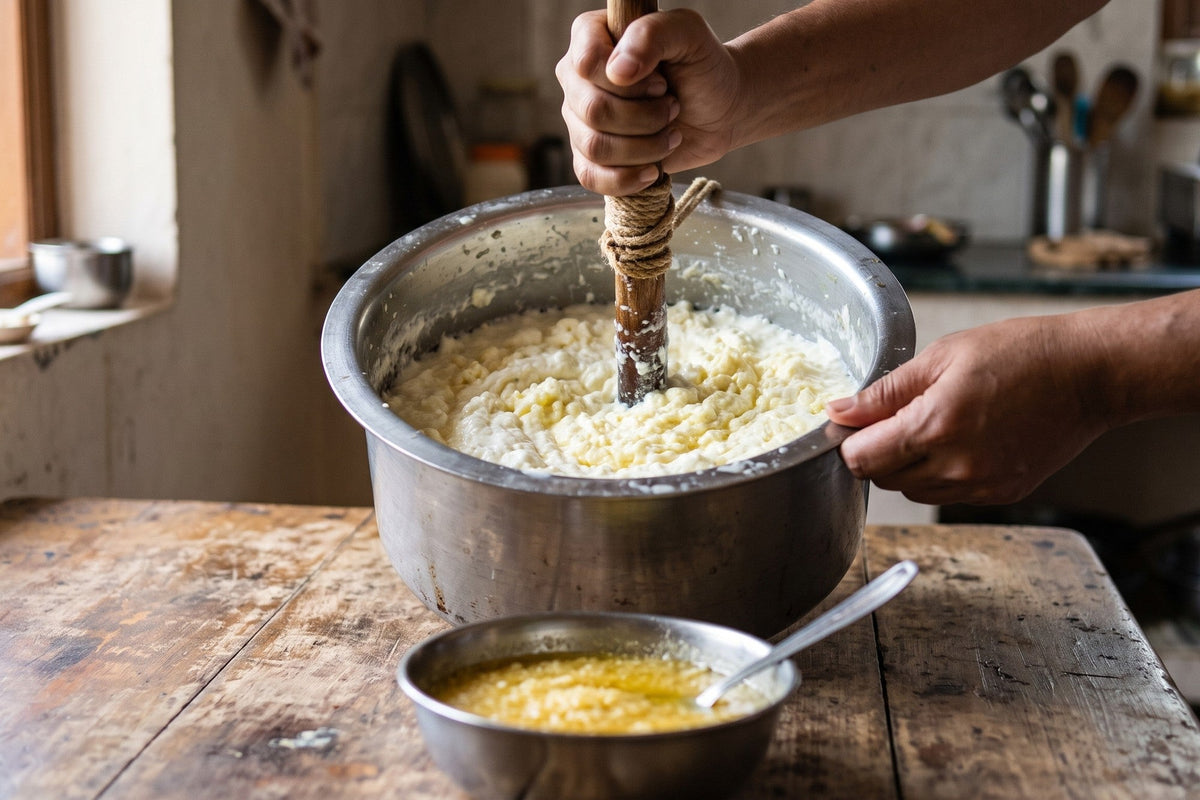
Desi khand is a crystalline sweetener made by boiling sugarcane juice and letting it set into coarse, pale-golden grains. It sits between white sugar, which is refined until the colour and most of the molasses are gone, and jaggery (gur), which is boiled juice set into a solid block without crystals.
That is the short answer. The rest of this page explains how each one is made, how they taste and cook differently, and when you would pick khand over the other two.
How is desi khand made?
The process starts the same way for all three sweeteners: cane is crushed and the juice is boiled down in large pans. What changes is how far the juice is taken and what happens next.

For khand, the thickened syrup is cooled and allowed to crystallise slowly, then the grains are separated and dried. Because it is not bleached to white, some of the cane's colour and molasses flavour stays in. The grains are uneven in size, and the colour runs from cream to light amber.
India's food regulator describes the two traditional products in its standards: FSSAI's regulation on sweetening agents defines khandsari sugar as sugar obtained from sugarcane juice by the open pan process, in crystalline or powder form, and cane jaggery as the product obtained by boiling or processing the juice pressed out of sugarcane.
How is khand different from white sugar?
White sugar goes through further refining and filtering until the crystals are uniform and white. Khand is less processed, so it keeps a mild caramel note that sugar does not have.
In the kitchen, this shows up in two places: the flavour is rounder, and in milk-based sweets the colour comes out warmer. Khand dissolves like sugar, and you can swap it for sugar by weight in most home recipes. Start with the same quantity and adjust to taste.
How is khand different from jaggery?
Jaggery is boiled juice poured into moulds and set as a block, so it contains all of the molasses and has a strong, earthy taste. It does not dissolve cleanly, which is why it is grated or melted first. Khand is crystallised, so it pours, measures and stirs like sugar, with a gentler flavour than gur.
| White sugar | Desi khand | Jaggery (gur) | |
|---|---|---|---|
| Form | Fine white crystals | Coarse, pale-golden grains | Solid block or paste |
| Flavour | Plain sweet | Mild caramel | Deep, earthy, molasses |
| Dissolves | Quickly | Like sugar | Needs grating or melting |
| Easy to measure like sugar | Yes | Yes | No |
What do people cook with desi khand?
Traditional uses are the ones where a soft caramel note helps: chai, kheer, halwa, laddoos and mishri-style sweets, and as a topping for fresh dahi. Some cooks grind a small amount first for baking and laddoos.

Our Desi Khand comes in a 500 g pack. You can find it with our other pantry sweeteners in the Honey & Sweeteners collection.
How should you store khand?
Keep it in an airtight jar away from steam. Khand is less processed than sugar and can take up moisture and clump in the monsoon. If it clumps, break it up and dry it in a low pan for a few minutes. Dry grains pour freely again.
Is khand better for you than sugar?
We do not make health claims about sweeteners. All three are sugars and are used by people in moderation. Choose khand for taste and tradition, not as a way to eat more sweet food.
FAQ
Is khand the same as mishri?
No. Mishri is a more refined rock-sugar form. Khand is coarser and darker, with more of the cane flavour left in.
Can I use khand in tea?
Yes. Stir it in just as you would sugar.
Can I replace sugar with khand one-to-one?
In most home recipes, yes, by weight. For baking, grind it finely first and adjust for taste.
Does khand taste very different from sugar?
The sweetness is similar. The difference is a mild caramel note, most noticeable in milk and in sweets like halwa.
What is the difference between khand and gur?
Khand is crystallised and pours like sugar. Gur is a solid block with a stronger molasses taste.